
These days I read a very interesting book by Prof. Giorgio Vallortigara, Kant’s Chick [1].
It is an essay that recounts the results of studies on the neuronal mechanisms of animal cognition obtained by his research groups and also by other researchers.
According to Vallortigara, all organisms currently living on Earth are all equally evolved, meaning they are the result of an evolutionary path that, starting from common ancestors, has led them to be as they are now through over three billion years of natural selection and random genetic mutations.
This also means that there are no superior or more evolved living beings, but simply beings that in their evolutionary path have taken different routes adopting different solutions to life’s challenges, also because “evolution is not improvement, but adaptation“ [1].
Instinct
The main question this essay tries to answer is whether animals are born with knowledge in their minds or if all knowledge derives from experience and learning.
In practice, are there innate knowledge? (even if this term is disliked by many).
Warning, spoiler 🙂 Well yes, in almost all 29 chapters of the book there is at least one experiment that supports this hypothesis. The experiments described have been conducted over the years on chicks and human newborns.
In fact, one of the things that struck me is the parallel and comparisons between the newborns of a species with helpless offspring, such as we humans, and the newborns of a species with precocial offspring (or early-developed) like chickens.
In both cases, there is knowledge already present at birth that allows newborns to have certain behaviors and that constitute the basis on which learning and experience will then shape the behavior of the adult individual.
Imprinting
Most of the experiments feature chicks and exploit a phenomenon known as imprinting. Basically, chicks, immediately after hatching, “develop a social attachment to the first thing they see” [1]. Simply put: the first thing they see is considered their mother and they start following and pecking it; it is a self-terminating phenomenon, meaning it starts as soon as a chick is born and ends when an object that can be accepted and possesses all the required characteristics is found.
This phenomenon is known thanks to the studies of ornithologist D.A. Spalding first and ethologist Konrad Lorenz (1903-1989) later, and is cleverly used to test the abilities of newly hatched chicks when they are not yet conditioned by any form of experience.
The video [7] I found on YouTube is really beautiful and explanatory on this topic and also explains the concept of critical period, that is the time within which imprinting must occur; from this somewhat dated video about ducks, the imprinting window is 0-30 hours from birth.
Some Experiments
So, there are knowledge already present at the moment of hatching, for example:
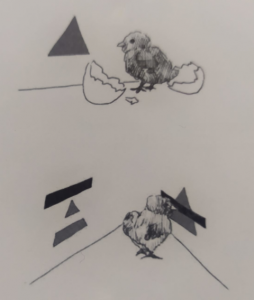
- Chicks, when choosing the object to imprint on, prefer objects with a head rather than objects without one or objects that are disassembled (like in a Picasso painting). This demonstrates an innate ability to recognize heads even if represented schematically. So a chick does not know exactly how the mother should look, but knows it must have a minimum number of requirements. Indeed, a chick does not imprint on a rock.
- Also at the moment of imprinting, they prefer objects that move in a “biological” or “semi-rigid” way (i.e., as a living being would move) over objects that move unnaturally. This shows they have an idea of natural movement.
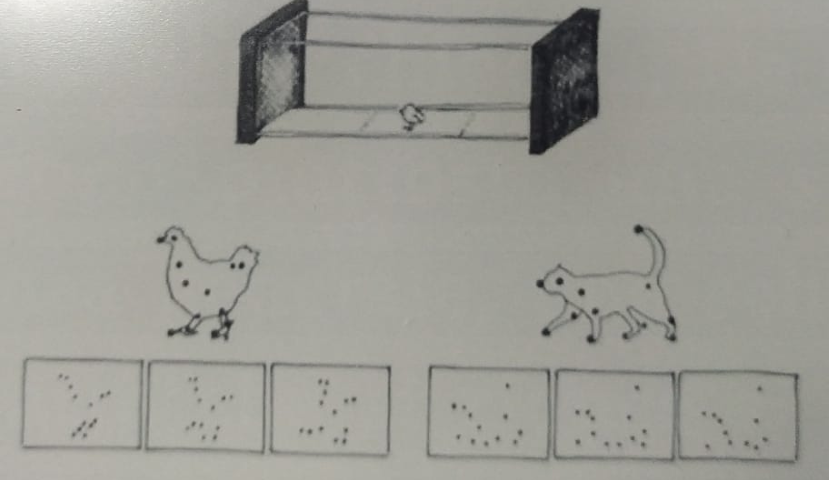
Author: Claudia Losi Book: Kant’s Chick - Faces or figures that are schematic and inverted are less preferred than those upright.
- They prefer objects that cause movement or move autonomously over objects that passively undergo movement (for example, being pushed by another object).
- Chicks can discriminate a solid object from a hollow one and choose the latter as the imprinting object, perhaps because it recalls the hollow space the hen creates with her wings to shelter them.
- It also seems that chicks can complete occluded objects, meaning they understand that an object is partially seen because it is behind another.
- They can tell if there might be an object behind a panel or not, because the panel is positioned so that it cannot hide anything due to limited space: “Children and chicks perceive objects as cohesive and continuous entities that extend in space and persist over time” and that “occupy space exclusively“.
- They prefer objects lit from above rather than from below, because in nature light comes from above.
- Chicks have a basic geometric sense in that they can find an object located in a particular corner of a rectangular room.
- Chicks freeze when they see a figure projected on a screen above their head moving, while they run away if this figure, for example a circle, enlarges (as if approaching). This is due to an instinctive response to the sight of a predator, also observed in adults who freeze when a predator passes by to avoid detection and run when the predator has seen them and attacks from above, getting closer and closer. On this topic, the video I found on Corriere one [8] is amusing.
- Chicks also have a basic arithmetic sense in that they prefer to move toward a location where there are more objects compared to one with fewer objects.
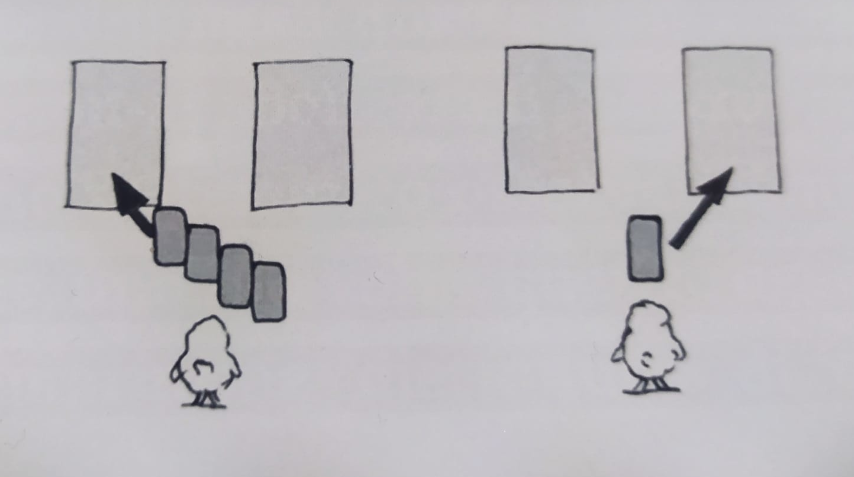
Author: Claudia Losi Book: Kant’s Chick - By moving objects from one position to another, they can tell where there are more objects, demonstrating a sense of number and arithmetic relations.
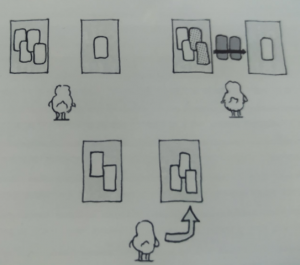
Author: Claudia Losi Book: Kant’s Chick
Conclusions
What I think I understood from this reading.
There is knowledge that is innate and, although simple, is already present when a newborn or a chick is born. This knowledge constitutes what we call instinct. Instinct is wired into the network of connections between neurons present in the nervous system and brain of each living organism. It is the DNA that contains the instructions for the “construction” of an organism, so it seems logical that it also contains the instructions for this “initial wiring” of neurons. We also know that some instinctive traits can be enhanced, slowed down, inhibited, and activated by external stimuli, but also by chemical substances such as hormones, pheromones, etc. Thanks to epigenetics, we also know that the phenotype (which is the manifestation of the genotype) is also influenced by the same external and chemical factors. Essentially, the evolutionary history of organisms has favored all organisms born with a genetic makeup similar to that of current organisms, a makeup that leads to the birth of a brain containing some information in the form of neural connections. This does not exclude that learning and experience can modify neural pathways causing behaviors different from instinctive ones.
That this whole mechanism is driven by chance and the three billion years life has had at its disposal is not easy to accept, but at the moment I do not believe there are other explanations.
Appendix – Comparison between living beings
While reading the book, I became curious about the complexity of the brain and DNA of some organisms and did a small research which I report in this table (not related to the book discussed in this post):
| Organism | # neurons | # chromosomes | # DNA bases | # genes |
| Human | 100 B | 46 | 3 B | ~ 25000 |
| Dog | 530 M | 78 | ||
| Bee (f) | 950 k | 32 | ||
| Elephant | 257 B | 56 | ||
| Fly | 250 k | 4 | 260 M | ~ 14000 |
| Pea | x | 14 | 4.8 G | |
| Tomato | x | 24 | ||
| Escherichia coli | x | 1 | 4 M | ~ 4300 |
Legend: B->billion – M->million – k ->thousand
Notes: The chromosomes of each species are grouped in pairs, for example in humans there are 2 pairs of 23, i.e., 46.
Sources: [2] [3] [4] [5]
Sources and References
- [1] Kant’s Chick, Giorgio Vallortigara, Adelphi.
- [2] MITx 7.00x Introduction to Biology – The Secret of Life by Eric S. Lander.
- [3] The Chromosome of Prokaryotes on the G.M.P.E. website
- [4] Various entries on Wikipedia.
- [5] The Genomes of Eukaryotes by Biometec.
- [6] Egg Hatching, Veneto Agricoltura – Interesting for egg incubation and fertility verification.
- [7] Vintage psychology study of imprinting in ducks. Behaviorism, duck science on YouTube – Interesting to see how imprinting occurs.
- [8] The Duckling and the Leopard video on Corriere.it.
*** Note: This article was automatically translated through a workflow created with n8n and OpenAI. The original version of the post is the Italian one.