
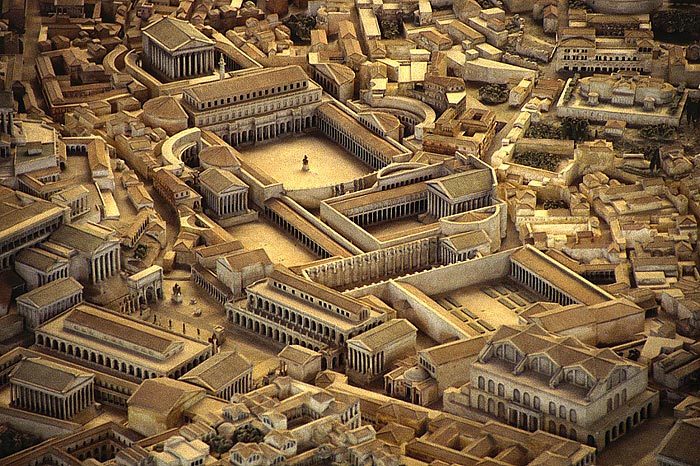
- What does “forum” mean?
- Imperial Forums, Roman Forum, and Foro Italico.
- The Alessandrino district.
- The Subura.
- The Forum of Caesar.
- The Forum of Augustus.
- The Forum of Vespasian.
- The Forum of Nerva.
- The Forum of Trajan.
- 3D reconstructions and virtual tours.
- Archaeology and theme parks.
- Photo gallery
What does “forum” mean?
In Roman times, this term referred to the main square that formed the religious, administrative, cultural, and commercial center of a city. It was usually rectangular in shape, surrounded by colonnaded porticoes, and could include within its perimeter a temple, a market, a basilica, a library, or other public buildings. At the time, the term basilica referred to a public building used for the administration of justice and commerce — essentially a courthouse. Forums were often located at the intersection of a city’s two main roads, the cardo maximus and the decumanus maximus.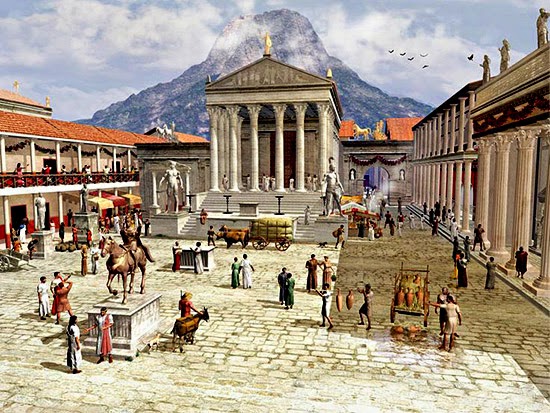 Forum of the city of Pompeii
Imperial Forums, Roman Forum, and Foro Italico
These terms are often confused, yet they refer to entirely different things. The Roman Forum is an archaeological area that was the nerve center of the city during the Republican era but continued to host important buildings during the Imperial period as well. This area underwent transformations throughout history but always included several basilicas and temples within its boundaries. The Imperial Forums are an archaeological area comprising five monumental squares built by Caesar, Augustus, Nerva, Vespasian, and Trajan, all located along the famous Via dei Fori Imperiali, which connects the Colosseum to Piazza Venezia. The two archaeological areas are adjacent. The Foro Italico, on the other hand, is something else entirely and is located in a completely different part of the city (near the Milvian Bridge): it is a sports complex built during the Fascist era, comprising various facilities including the Stadio Olimpico, the Stadio dei Marmi, and the tennis courts that host the Italian Open.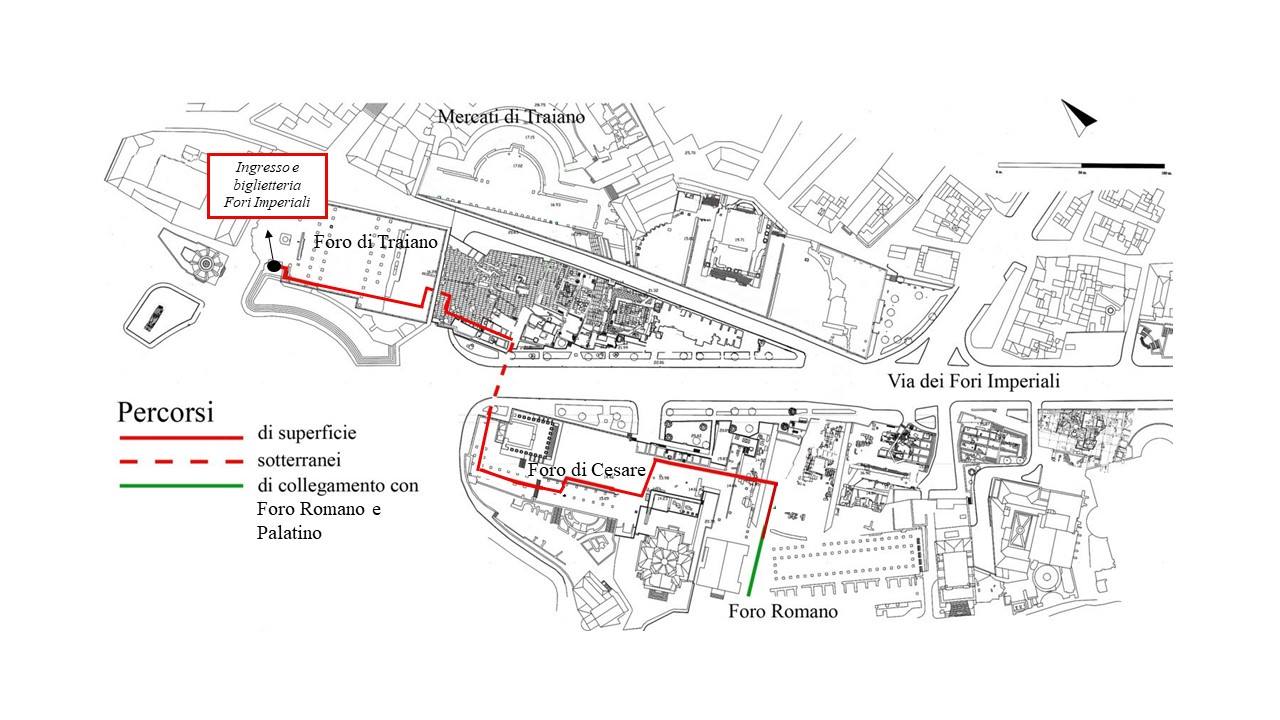 The Roman Forum is adjacent to the Forum of Caesar, which is part of the Imperial Forums
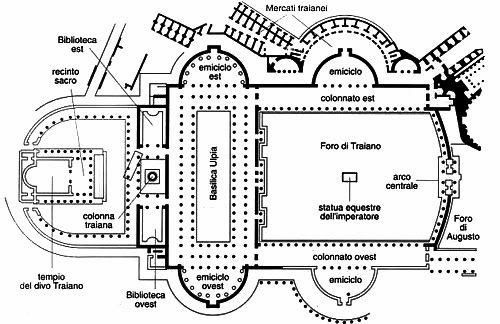
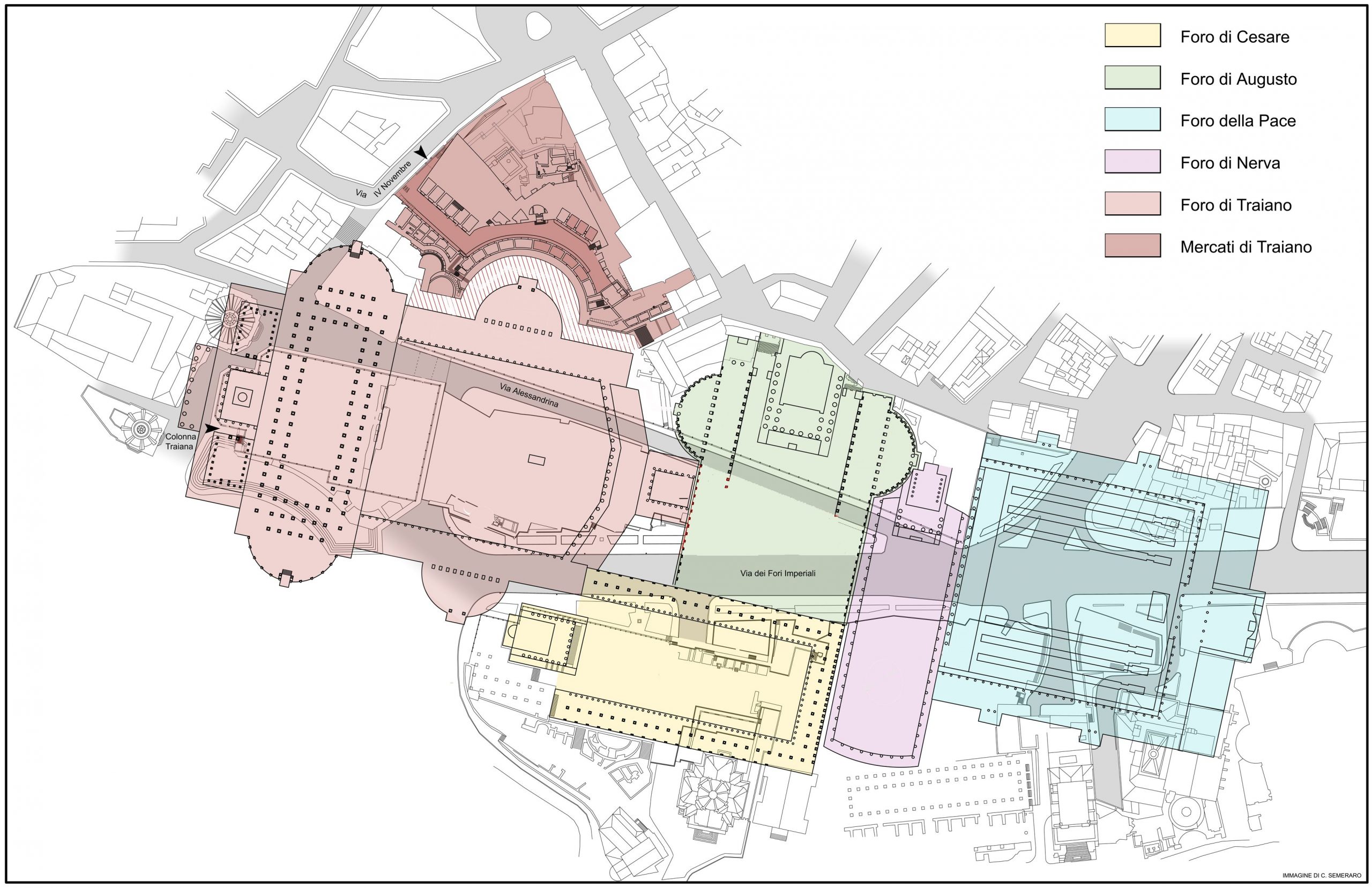 Map and layout of the Imperial Forums
The Alessandrino District
The Imperial Forums were brought to light during the Fascist period, when the regime decided to build a grand thoroughfare connecting the Colosseum to Piazza Venezia, intended both for military parades and to celebrate the glory of the Roman Empire. This road was first called Via dell’Impero and later Via dei Fori Imperiali. It was already known that the ruins of the imperial squares lay in that area, but over the centuries a neighborhood had grown up there, known as the Alessandrino district, with houses, churches, shops, and monasteries. Meanwhile, much of the marble and building materials from the forums’ structures and colonnades had been recycled for later construction. During the Fascist era, the entire district was razed to the ground to make way for the imposing road that would cut through the uncovered Roman ruins.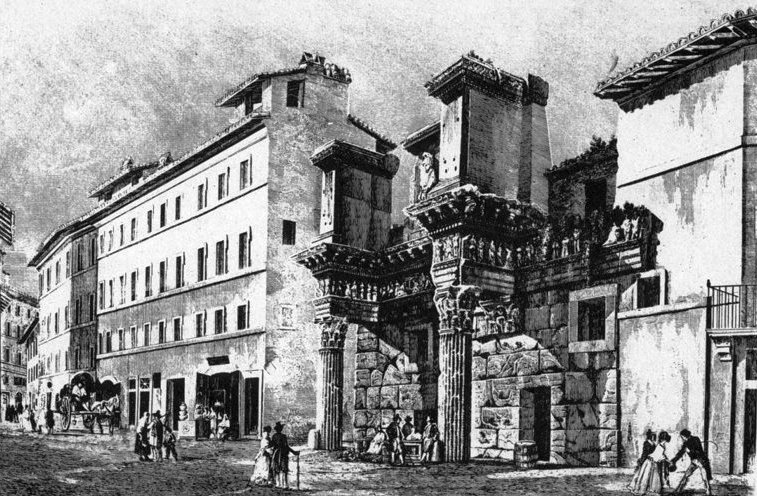 Via Alessandrina in the Forum of Nerva
The Subura
The Subura was a working-class neighborhood of ancient Rome that bordered the area where the Imperial Forums stood. Its inhabitants were poor and lived in miserable conditions, which is why the term still evokes a disreputable place, a setting for crime and corruption. It is no coincidence that a well-known Italian TV series about corruption and criminality in Rome is titled Suburra.The Forum of Caesar
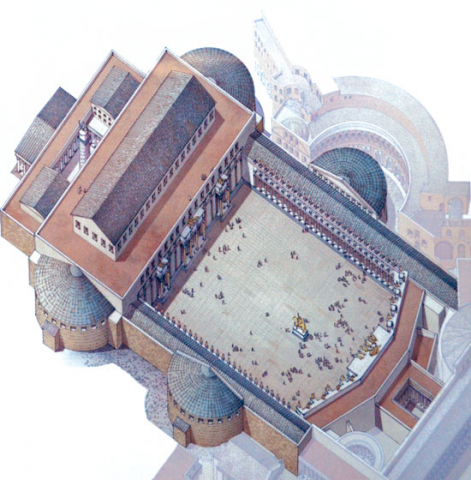
It is the only one of the five forums not built by an emperor. Caesar (100 – 49 – 44 BC), when he was assassinated, had just had himself proclaimed dictator for life but was not formally an emperor. The Forum of Caesar was a long, narrow square (160 x 75 metres, 12,000 m2) with a double portico on three sides and a temple dedicated to Venus Genetrix on the fourth. At the center of the square stood an equestrian statue of Caesar. The temple had eight columns on the front, columns along the sides but not at the rear; it was raised on a podium and accessed via lateral staircases, with two fountains flanking the façade. As early as the Gallic War (54 BC), Caesar had commissioned Cicero to purchase land near the Roman Forum with the intention of building a new square, which was eventually constructed between 51 BC and 46 BC following the victorious Battle of Pharsalus against Pompey. The square served a propagandistic purpose: the temple dedicated to Venus celebrated both Rome’s military greatness and the noble origins of the gens Iulia, of which Caesar was a member, claiming direct descent from Venus through Aeneas.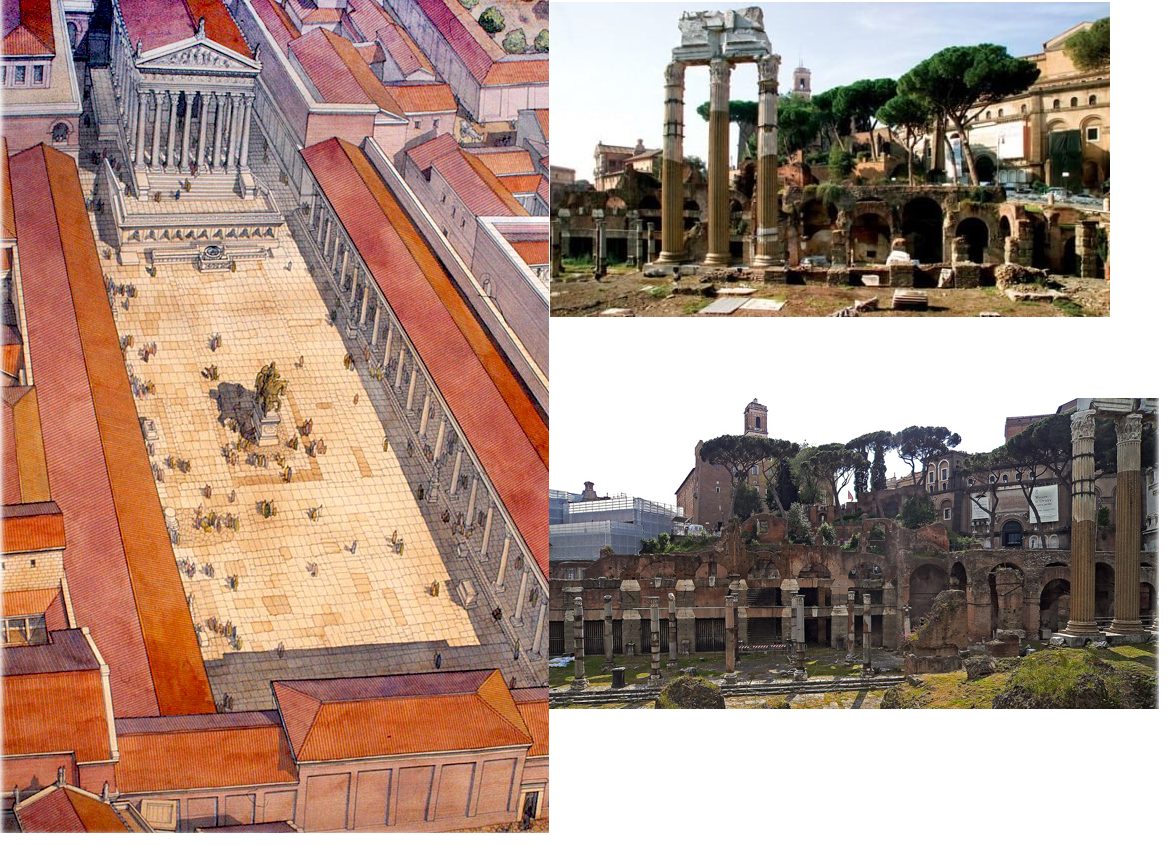 The Forum of Caesar: historical reconstruction and current state
The Forum of Augustus
Chronologically the second forum to be built, the Forum of Augustus (63 – 29 – 14 BC) was commissioned by Rome’s first emperor and inaugurated in 2 BC. It is adjacent to — and perpendicular to — the Forum of Caesar. The Forum of Augustus was a very large square (118 x 125 metres, nearly 15,000 m2) with lateral porticoes on the long sides and a temple dedicated to Mars Ultor (“the Avenger” — its construction had been vowed by Augustus after defeating the assassins of Caesar at the Battle of Philippi in 42 BC) on the fourth side. The temple stood on a podium and was accessed from the front via a staircase of 17 steps. An altar on the staircase was used for public ceremonies and sacrifices. As in all temples of the era, only priests could enter the cult chamber where the statue of the deity was housed. The temple had a pediment very similar to those of Greek temples, painted with colorful depictions of Venus, her son Eros, Mars, Romulus, the Goddess Fortuna, and the Goddess Roma. A 30-metre-high wall at the rear of the temple separated the square from the Subura. At the center of the square stood a monumental statue of Augustus driving a quadriga. At the ends of the porticoes, level with the temple, were two large semicircular covered spaces called exedrae (a type of apse): one housed statues of the legendary Trojan ancestors of the Romans and of the gens Iulia (Aeneas and Anchises), and the other held statues of illustrious figures from Roman history. One of the porticoes also contained a hall where Emperor Claudius later placed a colossus — an enormous statue of Augustus. This hall also displayed paintings by the Greek artist Apelles depicting Alexander the Great. The Forum lost importance after the construction of the other imperial forums, and the temple was demolished in the 6th century AD. In the 9th century, the church of San Basilio was built on the temple podium, occupying other forum structures as well.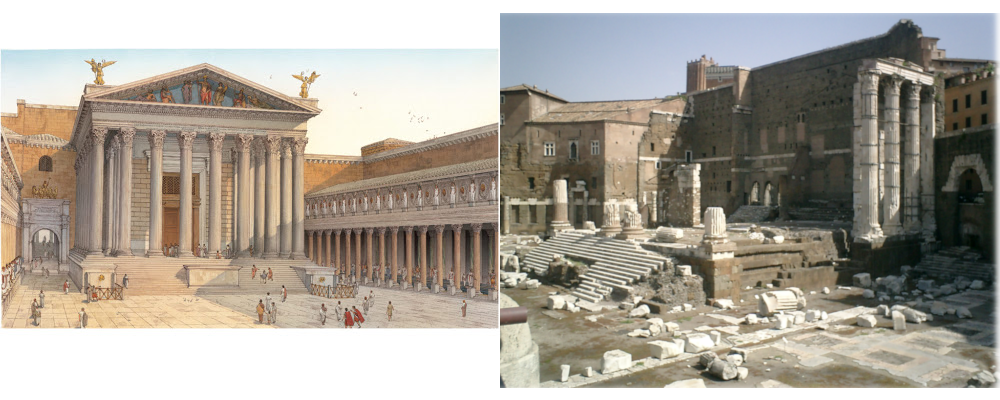 Forum of Augustus: historical reconstruction and current state
The Forum of Vespasian
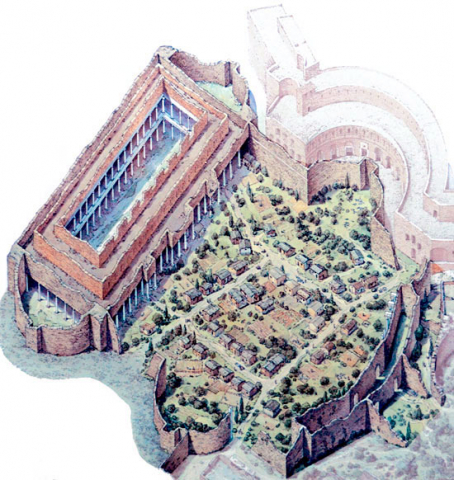
The Forum of Vespasian, also known as the Forum of Peace, was built to celebrate the Pax Romana imposed and achieved after the Jewish revolts that led to the destruction of Jerusalem in 70 AD. Inaugurated in 75 AD, the forum was a large quadrilateral (135 x 100 metres, 13,500 m2) surrounded by porticoes on all four sides, with a temple dedicated to the Goddess Pax set into the rear portico on one side. The central area of the square was adorned with artificial pools, hedges, and benches — it looked almost more like a park than a square — and must have been so striking that the historian Pliny called it one of the wonders of the world. Along the porticoes were public buildings and art exhibitions: a Greek library, a Latin library, a public museum of Greek artworks, the spoils of Jerusalem (treasures from the sack of the Temple of Jerusalem), and original masterworks looted by Nero from Greece and Asia Minor to adorn his Domus Aurea. The Temple of Peace was destroyed under Commodus (161–180–192) in a fire in 192 AD, but rebuilt by Septimius Severus (145–193–211). Septimius Severus had the famous Forma Urbis Romae — the large map of Rome (18×13 metres) engraved on marble — affixed to a hall adjoining the cult chamber. Fragments of it (10–15%) have been recovered and have proved invaluable for reconstructing the layout of ancient Rome. The remains of this temple are very scarce and are incorporated into the Church of Santi Cosma e Damiano.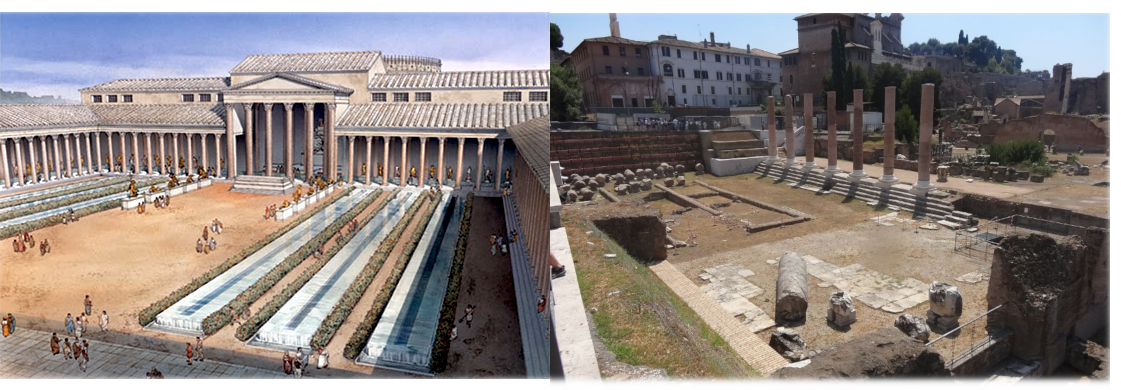 Forum of Vespasian (of Peace): historical reconstruction and current state
The Forum of Nerva
The Forum of Nerva (30 – 96 – 98 AD) was in fact built almost entirely by Emperor Domitian (51 – 81 – 96 AD), who was assassinated in a conspiracy and did not live to see the completion of the works or the inauguration, which took place in 97 AD. This square is also known as the Forum Transitorium because it connected the area of the Forums of Caesar and Augustus with the area of the Forum of Vespasian, and because it occupied part of the Argiletum, the street that linked the Forums to the Subura. The complex therefore occupied the free space left between the two preceding forums — a long, narrow rectangle (120 x 45 metres, 5,400 m2). The long sides had no porticoes but featured columns, and one of the short ends housed a temple dedicated to Minerva. The temple projected into the square with only its pronaos (the space between the cella and the front columns — essentially the antechamber of the cult chamber). The opposite end was curvilinear in plan and may have housed a temple, though this is not certain. Today only two portions of the forum are visible, separated by Via dei Fori Imperiali; the most famous are the “Colonnacce,” two columns that formed part of the perimeter wall.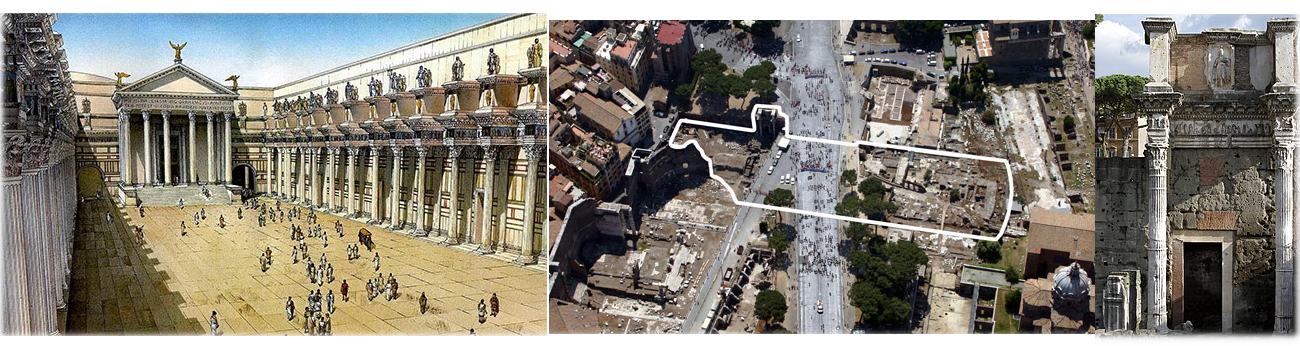 Forum of Nerva (Domitian): historical reconstruction and current state
The Forum of Trajan
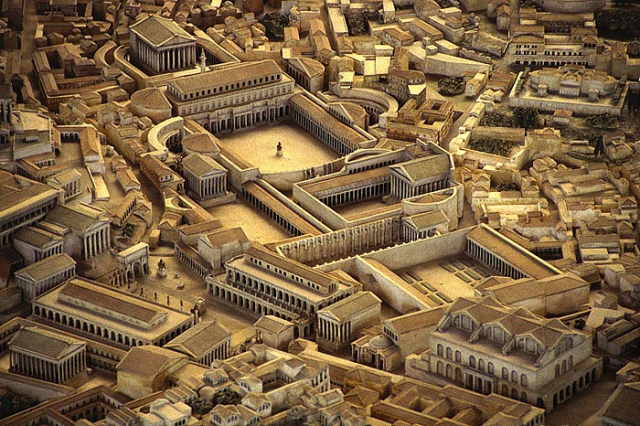
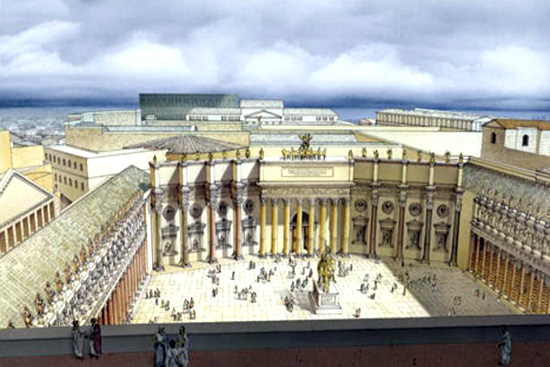
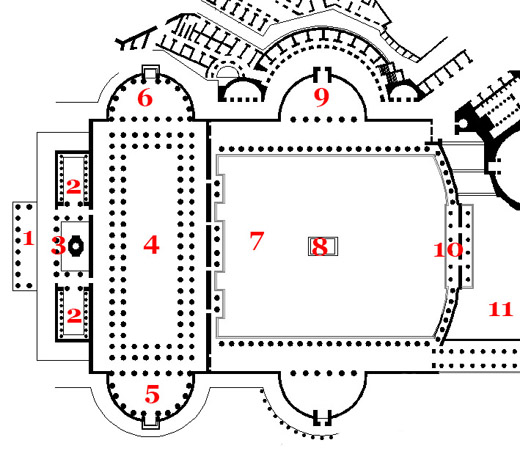
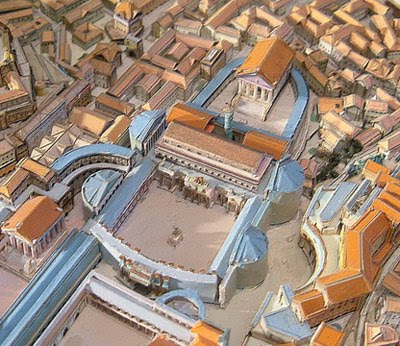
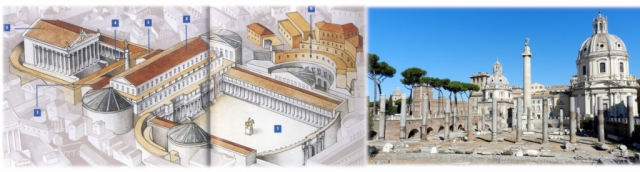
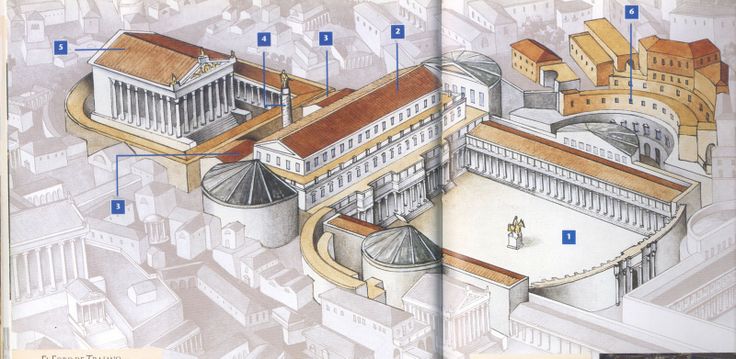
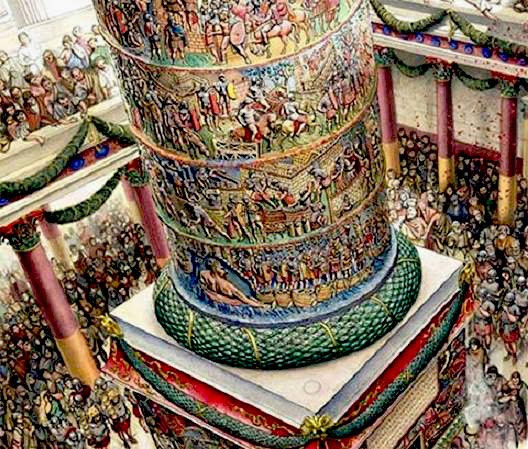
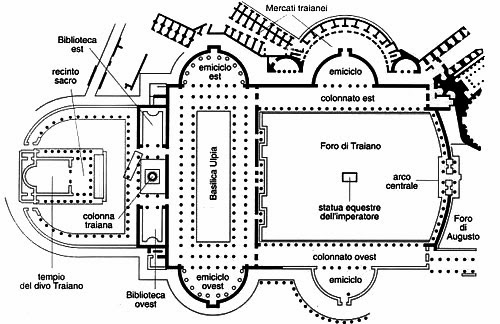
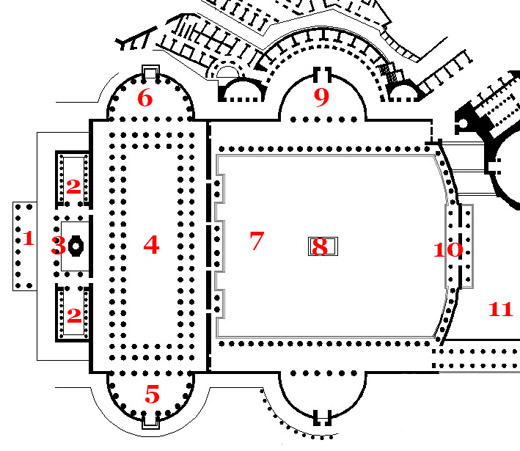
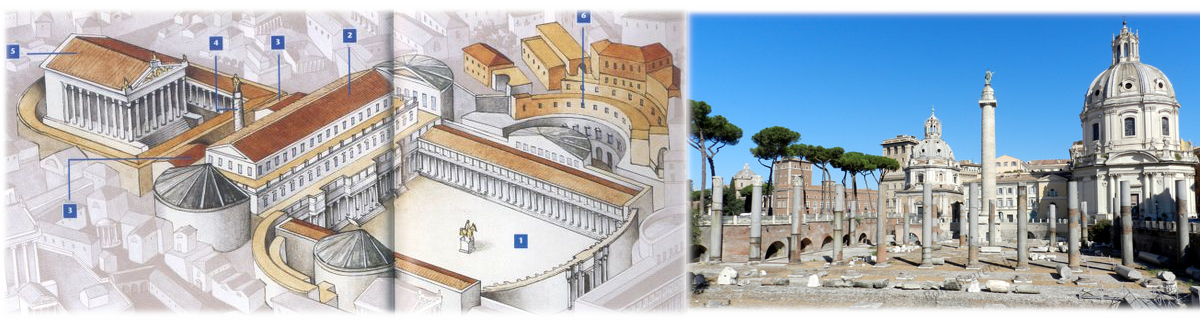
Marcus Ulpius Nerva Traianus (53 – 98 – 117 AD), who was a skilled general before becoming emperor, belonged to the gens Ulpia, which lived in Andalusia but had Umbrian origins. Under his reign the Roman Empire reached its greatest extent — 5 million square kilometres — thanks to the conquest of Armenia, Assyria, and Mesopotamia. But it was above all the conquest of Dacia (present-day Romania) that brought the emperor enormous wealth, as the region was rich in gold and silver deposits. This allowed the emperor to finance the construction of the largest of the forums and many other monuments, including the baths and the markets. The Forum of Trajan (also known as the Forum Ulpium) was inaugurated in 112 AD, covered an area of over 54,000 m2 (300 x 185 metres), and was built by levelling a saddle of land connecting the Capitoline to the Quirinal Hill, to a design by the celebrated architect Apollodorus of Damascus. The structure of the forum was complex: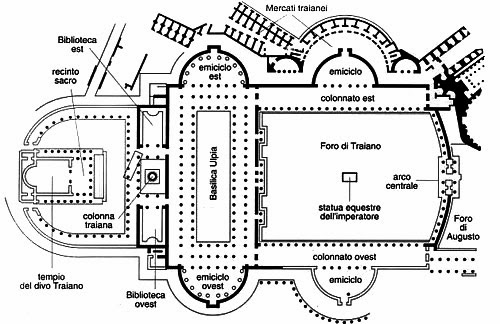 Plan of the Forum of Trajan
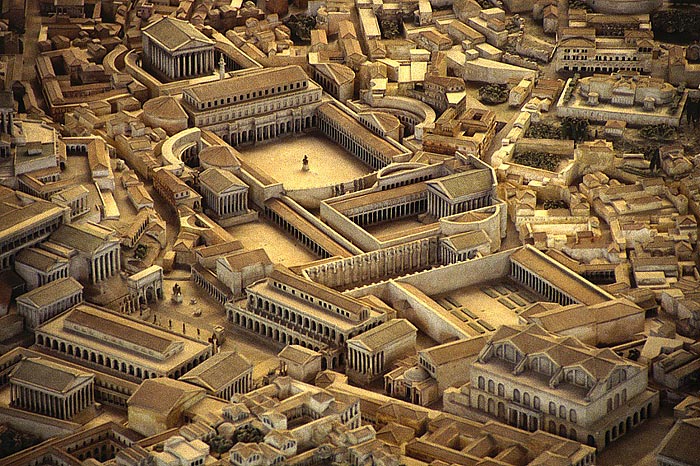
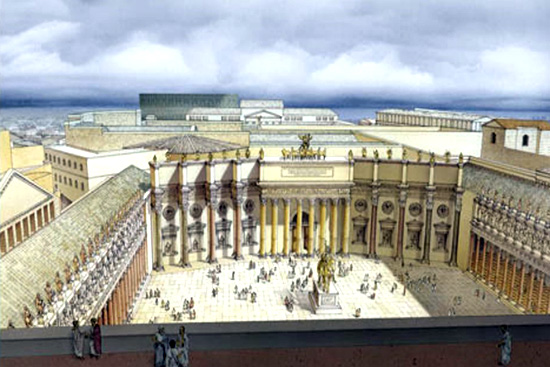
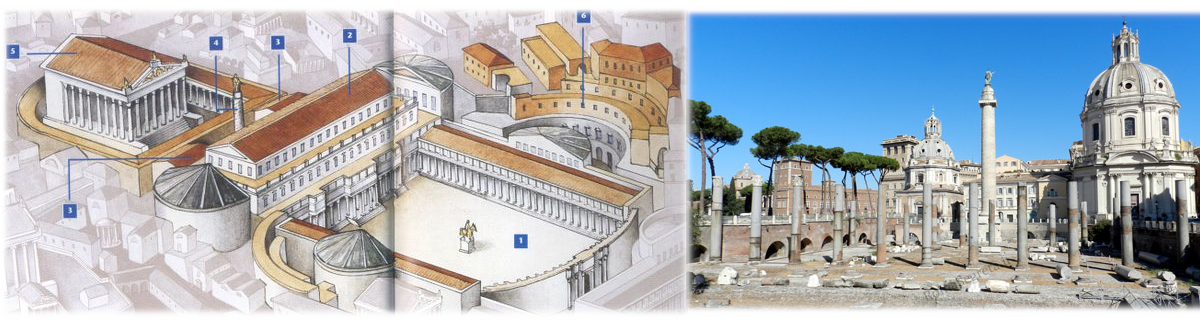 Forum of Trajan: historical reconstruction and current state
3D Reconstructions and Virtual Tours
While researching the Forums online, I came across a video produced by Altair4 Multimedia, a company specializing in 3D animation and virtual reality for historical subjects. The video is available on YouTube under the title Roma Imperiale and features stunning reconstructions of the main monuments of ancient Rome: the Colosseum, the Circus Maximus, the Imperial Forums, and more. Since this company counts prestigious clients such as RAI and National Geographic, I assume the reconstructions are based on solid research and are realistic and well-crafted. If so, this strikes me as an excellent way to appreciate a historical site — seeing it in its entirety, from different angles, and comparing its current state with the reconstruction. It gives an overall picture that is hard to achieve when standing on site, especially when very little remains, as is the case with the Imperial Forums. That said, the experience of visiting a place in person and “breathing in” the atmosphere of a millennia-old city is something no video, however well-made, can replace.Archaeology and Theme Parks
During the virtual tour led by Ferdinando and Marco of ItineRoma, the discussion touched on the fact that Italian archaeologists, after discovering a site, focus on preserving and showcasing the finds but do not attempt to reconstruct environments for dramatic visual effect. At most, they try to reassemble small parts of a monument using original pieces, in order to convey a sense of what things originally looked like. I believe this is the right and respectful approach — trying to reconstruct something that is not fully known, using different materials, would have no historical or scientific value. In the United States, the Middle East, and Arab countries, there are highly faithful reconstructions of entire Western cities, but they have no historical or architectural value: they are copies that cannot be compared to the originals. That said, if a theme park were ever built near Rome faithfully reconstructing — as Altair4 does — the Imperial Forums or other historic monuments, I would happily visit it. But to do the job properly, the costs would be so high and the required research so extensive that I doubt it would ever be feasible.Photo Gallery
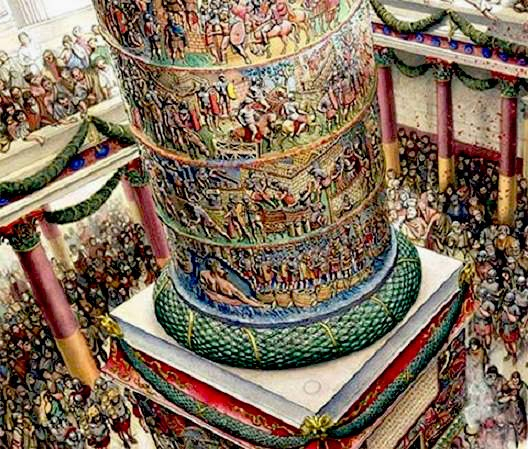
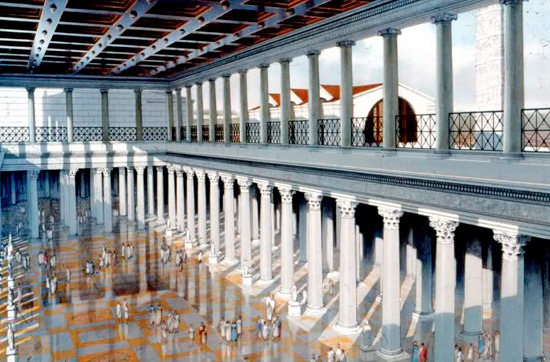
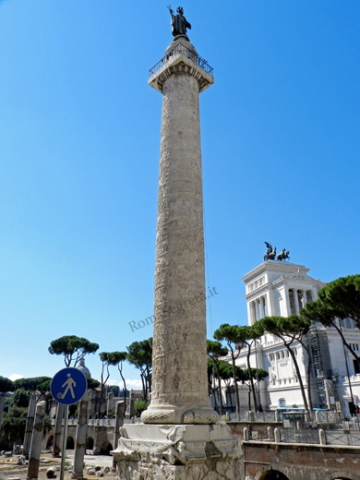
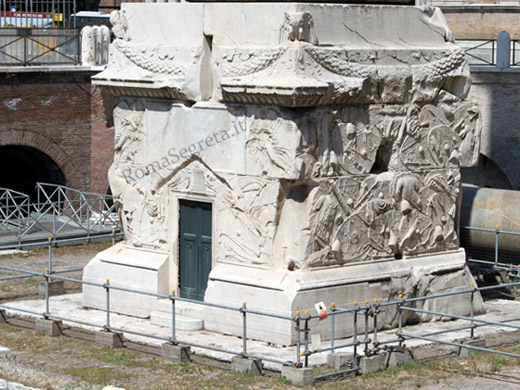
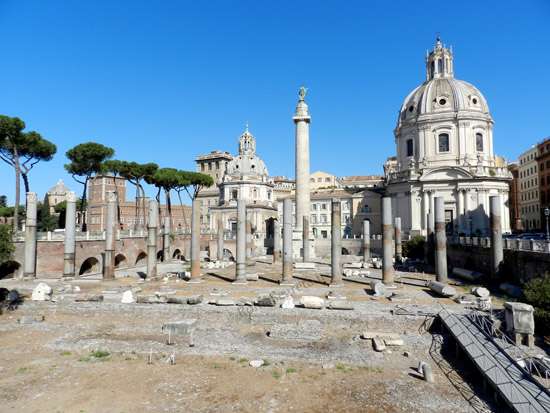
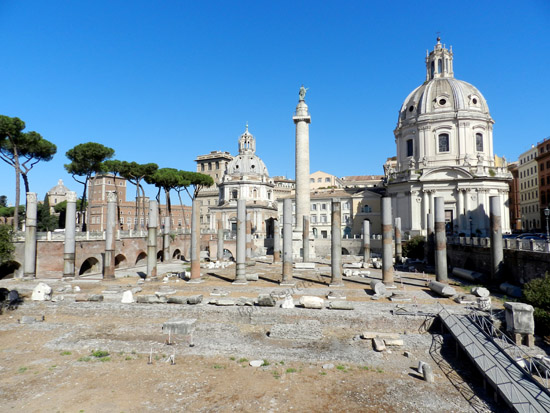
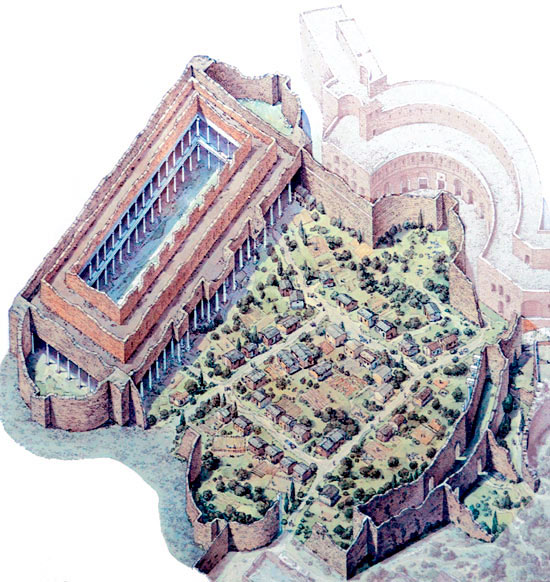
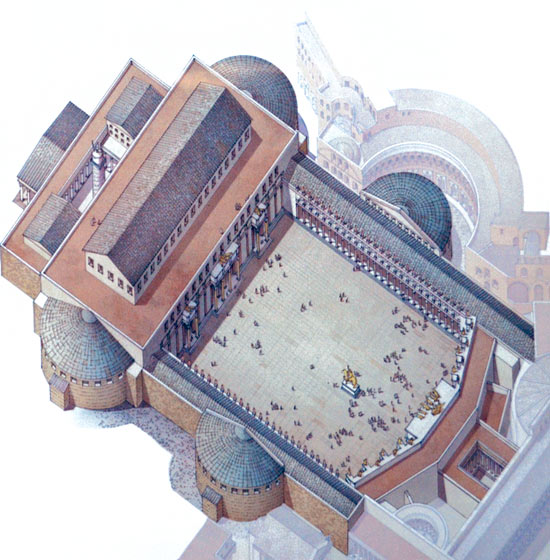
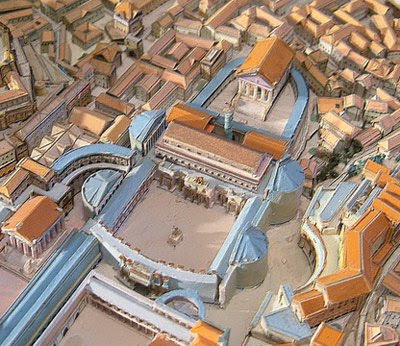
A selection of photos of the Imperial Forums’ remains found online: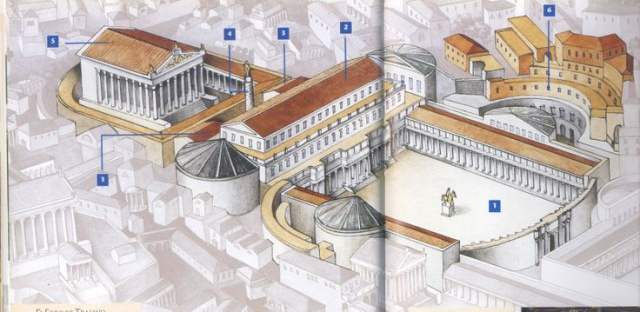
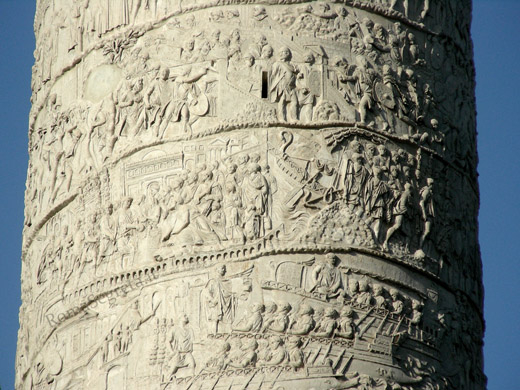
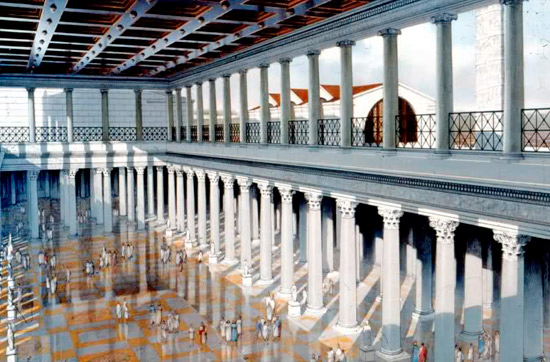
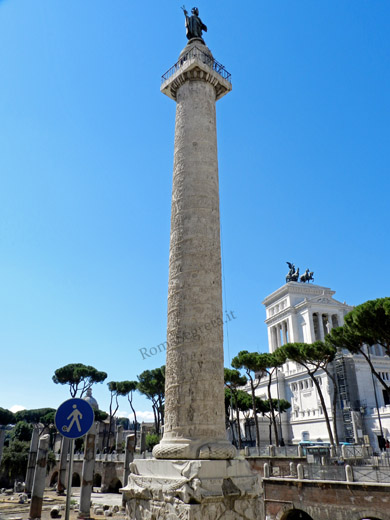
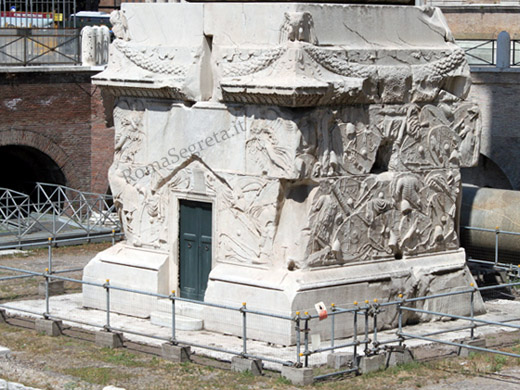
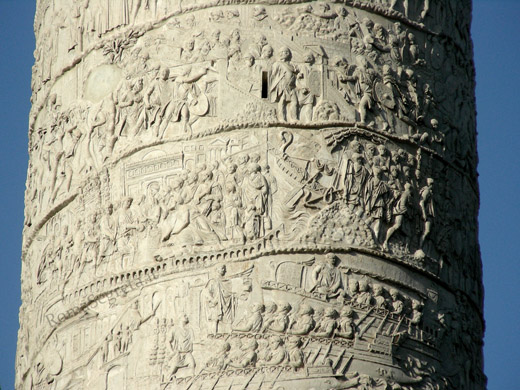
Sources and references:
- ItineRoma: Culture made fun.
- ItineRoma: Guided tour of the Imperial Forums.
- ItineRoma: Guided tour of the Roman Forum.
- The forum in the Treccani Encyclopedia.
- The Roman basilica on Wikipedia and on Romanoimpero.com.
- Via Alessandrina on Wikipedia.
- Forma Urbis Romae on Wikipedia.
- The Forum of Caesar on Wikipedia, on Romasegreta.it, and on Romanoimpero.com.
- The Forum of Augustus on Wikipedia, on Romasegreta.it, and on Romanoimpero.com.
- The Forum of Vespasian on Wikipedia, on Romasegreta.it, and on Romanoimpero.com.
- The Forum of Nerva on Wikipedia, on Romasegreta.it, and on Romanoimpero.com.
- The Forum of Trajan on Wikipedia, on Romasegreta.it, and on Romanoimpero.com.
- List of Roman Emperors on Wikipedia.
- The Basilica Ulpia on Wikipedia.
- Trajan’s Column on Wikipedia.
- Roma Imperiale, 3D reconstruction by Altair4 Multimedia.
- Museo della Civiltà Romana: houses scale models of Imperial Rome reconstructions.
*** Note: This article was translated using an automated workflow built with n8n and OpenAI.