
Ancestors – Lucy and Other Stories from Deep Time
These days I have read the latest book by Prof. Giorgio Manzi, which collects a series of writings on some important paleoanthropological discoveries and some highly significant fossils, some of which were found in Italy.
Unlike other books [2], this time Manzi uses a literary device to link the chapters together. He imagines, in fact, that these are texts discovered by visitors from an extraterrestrial civilization while conducting research on our now uninhabited planet, after the extinction of the human race caused by poor management of the planet and its resources.
Thanks to these findings, the extraterrestrials understand that humans were intelligent beings and that, before becoming extinct, they had reached a certain level of awareness and understanding of their history and the phenomenon of evolution that had led them to change over the millennia.
The ten chapters of the book cover various very interesting topics: the science of paleoanthropology, the birth and establishment of the theory of Evolution thanks to Darwin and Wallace, the Piltdown skull hoax, and then, from chapters 4 to 10, the story of the discovery of a particular fossil is taken as a starting point to clearly and engagingly summarize the current state of knowledge about the history of hominin evolution, from the first descendants of the common ancestor with chimpanzees to the last species still around: Homo sapiens. All this passing through the other now extinct species that have succeeded each other over the last 6-7 million years.
The book, compared to others by the same author, does not propose particular novelties, but it is still an interesting journey through the millennia, which leads us to reflect on the history of our planet and to ask many questions that often still have no definitive answer. Moreover, the anecdotes about the discoveries make it smooth and enjoyable to read.
That said, in my opinion, a text of this kind would be even better if accompanied by diagrams and images that help to understand what is being discussed.
I understand that, in this way, the number of pages, the complexity and the cost of the book would increase, but it is still nice to be able to visualize the things you read about.
So I decided to create some diagrams on my own and to search the Internet for images that could illustrate each chapter, so if one day I need to reread it, I will do so consulting this image archive.
I report below the result of this small work.
Hominin Diagram
This image represents all the hominin species discussed and clearly shows the temporal relationships between them:
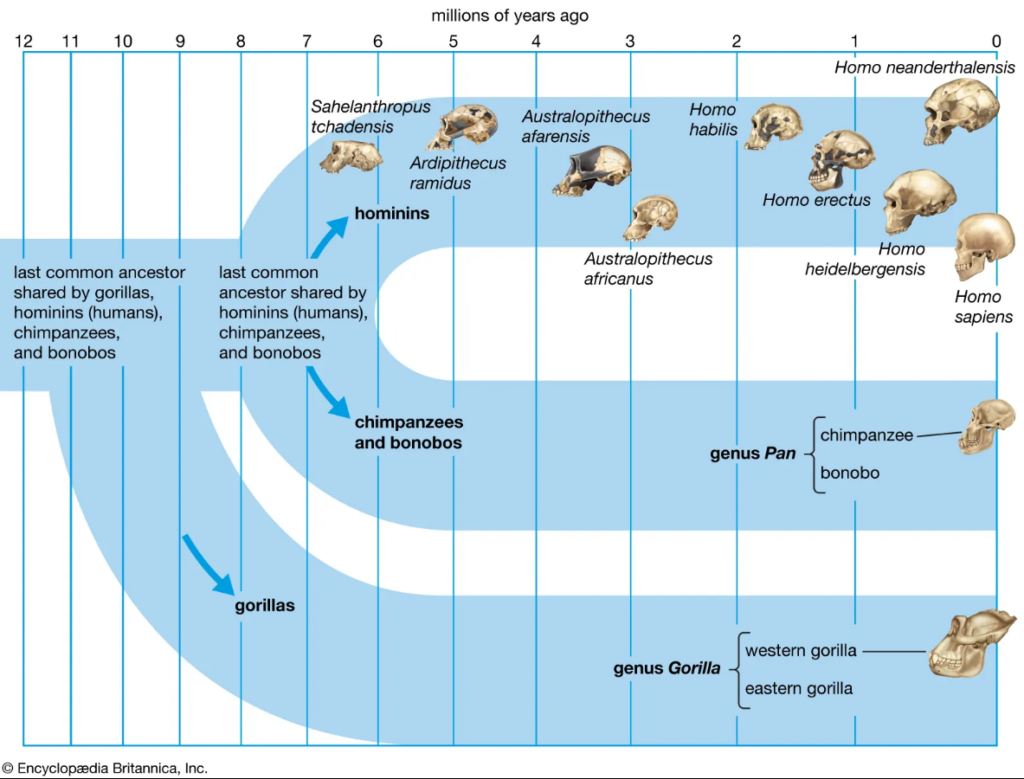
Each chapter of the book (from the fourth to the tenth) discusses the story of the discovery of a key fossil in understanding human evolution. Here is a summary of these 7 fossils:
| Informal Name | Identification Code | Attributed Species | Discovery: date – site – location – country | Dating |
| Lucy | A.L. 288-1 | Australopithecus afarensis | 1974 – Hadar site – Hafar region – Ethiopia | ~ 3.2 Ma ** |
| Turkana boy | KNM-WT 15000 | Homo ergaster | 1984 – Nariokotome deposit – Lake Turkana – Kenya | ~ 1 Ma |
| Flores Man* | LB-1 | Homo floresiensis | 2003 – Liang Bua cave – Flores Island – Philippines | ~ 190-50 Ka |
| Argil or Ceprano Man | Ceprano 1 | Homo heidelbergensis | 1994 – Ceprano site – Frosinone – Italy | ~ 430-385 Ka |
| Circeo Man | Guattari 1 or Circeo 1 | Homo neanderthalensis | 1939 – Guattari cave – Circeo – Italy | ~ 60-50 Ka |
| Altamura Man | – | Homo neanderthalensis | 1993 – Lamaluga cave – Altamura – Italy | ~ 172-130 Ka |
| Oetzi or Similaun Man | – | Homo sapiens | 1991 – Similaun glacier – Trentino – Italy | ~ 5300 years ago |
* This species is also called Hobbit, while the island’s natives referred to similar individuals in their oral tradition as Ebu Gogo or Lai Ho’a, now extinct.
** Ma = million years ago – Ka = thousand years ago
Photos of These 7 Fossils***
**** The images in the article and photo gallery are taken from Google Images. We cannot verify copyright or trace the authors. If an author notifies us, we will gladly indicate the source or remove the image if requested. You can use the site contact form for such reports.
These are photos of the fossils and their reconstructions made by very talented paleoartists [7][8]:
Map of Archaeological Sites
Here is the link to a map of archaeological sites mentioned in the book (actually there are also sites only cited and others I added because I found them during this research).
The sites on the map are colored based on the species discussed, according to this criterion and these colors:
- mixed findings, Ardipithecus ramidus
- Australopithecus africanus, A. afarensis, A. sediba
- early Homo, Homo habilis, Homo ergaster
- Homo erectus
- Homo georgicus
- Homo naledi, Homo floresiensis, Homo luzonensis, Denisovan Homo
- Homo heidelbergensis
- Homo neanderthalensis
- Homo sapiens
Other Photos***
**** The images in the article and photo gallery are taken from Google Images. We cannot verify copyright or trace the authors. If an author notifies us, we will gladly indicate the source or remove the image if requested. You can use the site contact form for such reports.
Here, sorted by chapter, are images that might help better understand the topics discussed:
Sources and References
- Giorgio Manzi, Ancestors – Lucy and Other Stories from Deep Time, il Mulino, 2024.
- Giorgio Manzi, Latest News on Human Evolution, il Mulino, 2017.
- Giorgio Manzi, The Great Story of Human Evolution, il Mulino, 2018.
- Ancestors: the map of archaeological sites cited in the book.
- List of fossil discovery sites on Wikipedia.
- Description of the Lomekwi 3 (LOM3) site on Wikipedia.
- The paleoartistic reconstructions of hominins by brothers Adrie and Alfons Kennis.
- The paleoartistic reconstructions of hominins by Elisabeth Daynes.
- Brief Chronology of Neanderthals in Italy by Francesco Piccardi on Pikaia.
- The Man from Flores Island, on this blog.
- Our Ancestors: When Man Became Such, on this blog.
*** This article was translated using an automated workflow built with n8n and OpenAI.