
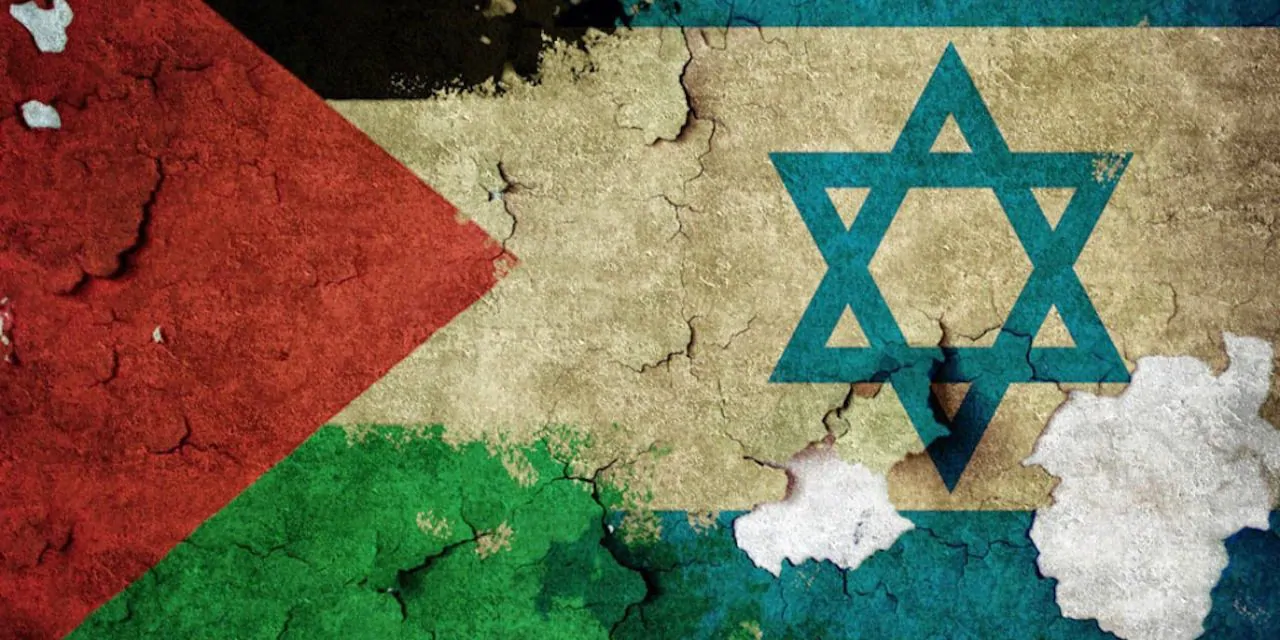
After summarizing in the post: “Whose is Palestine? The Origins of the Palestinian Issue“, the key events that have shaped the history of Palestine, it was inevitable to reflect on the conflict between Palestinians and Israelis. I am not an expert in geopolitics, so these are personal opinions born and remaining in this blog.
First of all, I ask myself: wouldn’t it be more accurate to define it as a conflict between Arabs and Jews? I say this because, in reality, since the birth of the Arab League, many nations have done nothing but interfere in this dispute, officially to defend the Palestinians, but in reality because they use this conflict to advance their struggle against the West and its culture. Another aspect is that these nations see Israel not as the oppressor from whom the Palestinians must gain independence, but as a state to be erased and see Israelis as a people to be exterminated. Typical goals of a religious war, not a war of liberation.
It follows that the first major obstacle to peace is this: the undue interference of foreign nations that have no interest in reaching a peaceful solution to the issue. In truth, Israel also has allies, foremost among them the United States, but these allies have always been interested in resolving the conflict quickly.
Regarding any presumed greater legitimacy of Palestinians or Israelis to govern the land of their ancestors, it must be said that the history of Palestine does not seem to favor either side. It can be said that Palestine, since ancient times, has always been inhabited and that it has been a land subjected to continuous and multiple invasions and conquests by foreign empires and nations. Yes, there were Jewish kingdoms, but in a land simultaneously inhabited by many non-Jews. It is true that most Jews left and dispersed around the world, but not by their own will. They were repeatedly expelled or deported from the Promised Land by force (Assyrians, Babylonians, Romans, Crusaders, etc.). It is also worth noting that at the time of the kingdoms of Israel, Muhammad had not yet been born and, even more so, Islam did not exist. Therefore, certainly, those who profess Judaism have lived in Palestine longer than those who profess Islam. Finally, even during the long period of Islamic rule (caliphates and Ottoman Empire), Palestine was a region where the few inhabitants were of different ethnicities and religions. All this to say that Palestine has always been a region where various peoples coexisted more or less peacefully and cannot be uniquely identified as the land of the Jews or the land of the Arabs.
So to whom should Palestine be assigned? Probably the best solution would be to definitively separate the religious aspect from the political one and create a single secular state as in all the richest and most advanced nations on the planet.
But this is a utopia; by now, the division between the two peoples has taken on such clear religious and cultural characteristics that it is impossible to imagine peaceful coexistence under the same flag. The hatred towards the other, which permeates both sides, is so intense that I do not believe it can be easily appeased (the series Fauda illustrates this aspect very well).
Therefore, for peace to reign in Palestine, the following must happen:
- The global public opinion should begin to distinguish the Palestinians (the battered population living in the Gaza Strip, the West Bank, and refugee camps in many neighboring countries) from Hamas and Islamic states. Hamas is a terrorist group; Islamic countries are fundamentalist states that finance jihad, which is a religious war. Palestinians should be helped, extremists marginalized. The only political body representing Palestine should be the PNA.
- Western countries and non-Islamic Arab countries should ally within the UN framework, also to protect their own interests, and intervene with diplomacy and intelligence so that Israel and the PNA reach a definitive agreement. A Peace Conference on this topic could be convened under the UN’s guidance.
- All these “willing” nations should officially recognize both states: Israel and Palestine.
- Israel should withdraw from the occupied territories (within which borders is difficult for me to say, as they have changed many times) and should allow the birth of an independent Palestinian state, renouncing all forms of control over it. The continuous expansion of settlements is one of the causes of this conflict.
- Palestinians should finally establish their own secular and independent state, and stop being influenced by Islamic states that have no interest in this happening and are only using the Palestinian issue for their propaganda purposes. They should focus on building a modern nation based on work, not religion.
- Both states, Palestinian and Israeli, should commit to protecting any Arab and Jewish minorities present in their territories. Another mass migration from one region to another is unthinkable.
- The international community should take responsibility for the reconstruction of Palestine by financing a kind of Marshall Plan that allows this nation to recover and not have to rely on funding from current allies.
- Jerusalem should be an independent city, a kind of city-state, an enclave, a free zone where everyone can profess their faith and go on pilgrimage (Jews, Muslims, Christians, Orthodox, etc.). Therefore, neither state should have it as their capital.
- UN peacekeepers should monitor the border areas, creating buffer zones and intervening militarily in case of terrorist attacks.
- The fight against fundamentalist terrorist groups should be relentlessly supported worldwide under the UN’s sponsorship. Unfortunately, these organizations cannot be dismantled peacefully.
- Intellectuals worldwide should stop taking sides but should try to use their influence to raise public awareness for peace and recognize the right to exist of both nations. Finally, they should isolate their fundamentalist or nationalist colleagues.
In these last days, immediately following the October 7, 2023 attack, in television debates, newspaper articles, and demonstrations on both sides, there has been a disgusting exploitation of recent events and past history. I do not know if this is due to ignorance, superficiality, or hypocrisy of these people.
The fact remains that becoming a partisan of one of the two factions only worsens things and distances peace.
Sources and References
- “Whose is Palestine? The Origins of the Palestinian Issue” on this same blog.
- Fauda on Netflix.
- The peace process between Israel and Palestine, what solutions have been proposed and why they failed by Geopop.
- Israel-Palestine escalation: 12 charts to understand how we got here on Ispionline.it.
- Occupied Palestinian territories, how the Palestinian issue was born by Save the Children.
*** Note: This article was automatically translated through a workflow created with n8n and OpenAI. The original version of the post is the Italian one.