
The concept of an Internet of Plants is not very recent; the first articles discussing it date back to around 2010, when the idea of using the high sensitivity of plants to climatic, environmental, and physiological changes for various purposes began to take shape. Essentially, the idea is to use trees and plants to collect data and propagate it through a network just like computers and servers do on the Internet.
In this context, “cyborg” plants are equipped with electronic sensors capable of measuring environmental parameters and transmitting them to microcontrollers, which in turn feed them into the network. All this data can then be propagated at various levels and used to:
- monitor the balance of entire ecosystems within the scope of environmental protection, detect pollution and the presence of toxic compounds, identify critical variations within a certain ecosystem,
- control the health of plants and trees and their behavior, within the field of neurobotany,
- track the evolution of entire crops within precision agriculture to determine, for example, when to irrigate or fertilize.
All this is possible because plants are sensitive and intelligent living beings.
Sensitive because they have the ability to detect changes in dozens of physical and chemical environmental parameters:
- Temperature
- Soil humidity
- Light intensity
- Photoperiod (day and night duration)
- Exposure to UV or IR rays
- Wind and mechanical movements
- Nutrient concentration: sulfur, potassium, nitrogen, etc.
- Soil pH
- Salinity
- Oxygen present in the soil
- Carbon dioxide present in the air
- Presence of gases
- Presence of pests: insects, fungi, bacteria
- Mechanical stresses: cuts, impacts, shakes, bites, etc.
- Presence of roots from other plants (root competition)
- Presence of mycorrhizae or bacteria
Intelligent because capable of solving problems and responding appropriately to external stimuli [1][2][3][5][6].
Just like the human brain, plants also respond to external stimuli through electrical signals that can be detected, identified, measured, and interpreted.
The work, however, is not simple because if electrical signals can be detected and measured, for example, using the same electrodes used in electromyography, it is then necessary to create a sort of vocabulary to understand the meaning of each of these variations.
Moreover, in addition to electrical signals, there are other magnitudes that can be considered:
- variations in impedance or conductivity
- sap flow
- stomatal opening
- hormone production
- VOC emission (Volatile Organic Compounds)
Finally, another aspect to consider is that plants and trees communicate with each other through: VOC, chemical secretions, mycorrhizal networks, and acoustic signals (infrasound or ultrasound, thus inaudible to humans) [3][4]. Therefore, intercepting these communications could also be useful for some applications.
Known Projects
Among the projects that have dealt with the Internet of Plants, the most relevant ones seem to be:
- PLEASED (PLants Employed As SEnsing Devices): This was a project funded by the European Commission under the FET (Future and Emerging Technologies) projects, aimed at studying and developing the concept of plants equipped with sensors to monitor environmental parameters (water availability, soil quality, pollution, stress, etc.) connected in a network to provide useful data to scientists and farmers. The research focused mainly on the integration of microsensors and their integration with plants to interpret biological signals and transform them into digital information. The study produced various articles and experimental prototypes of sensors and protocols for their use. This project was developed from 2012 to 2015, and it seems there have been no further developments.
- CROPPS (Center for Research on Programmable Plant Systems): This is a research center funded by the National Science Foundation (NSF) of the United States, aimed at creating technologies and systems for bidirectional communication with plants, meaning not only listening to the biological signals of plants but also potentially responding, programming, and modifying certain aspects of their behavior. The goal is to be part of what is called the Internet of Living Things (IoLT), an expansion of the IoT (Internet of Things) idea applied to living organisms. The project aims to understand how plants interact with the environment and how to translate this into useful information for sustainable and resilient agriculture. The project started in 2021 and is still ongoing. The research center is multidisciplinary, involving the departments of biology, computer science, engineering, and botany from many universities, and is trying to establish a new discipline of Digital Plant Biology that combines biological signals and network technologies. The stated goal is to design commercial services and products.
The fact that both the European Commission and the United States government have funded or are funding such research suggests that these are not futile studies and research, but a research field that could have not only great scientific value but also significant economic implications. The American center, in fact, is very oriented towards the agricultural and productive world rather than the environmental one.
System Architecture
In this context, it seems like a good idea to ally with plants and trees, take care of them, and “collaborate” with them to have a connected and global system that allows for the collection of a huge amount of data which, when properly processed, can lead to significant technological developments and scientific progress.
The technologies to create such a system already exist, both from a sensor perspective and from a data collection perspective (protocols, infrastructures, and devices); not to mention that with the advent and spread of Artificial Intelligence, data analysis and the extraction of information and predictions from it should not be very difficult.
The architecture of such a system could be like this:
In this scheme, data analysis and management are developed on four levels (IL-IVL), but there could be others. At each level, data is collected and sent to an aggregator, which in turn becomes a node of the next level.
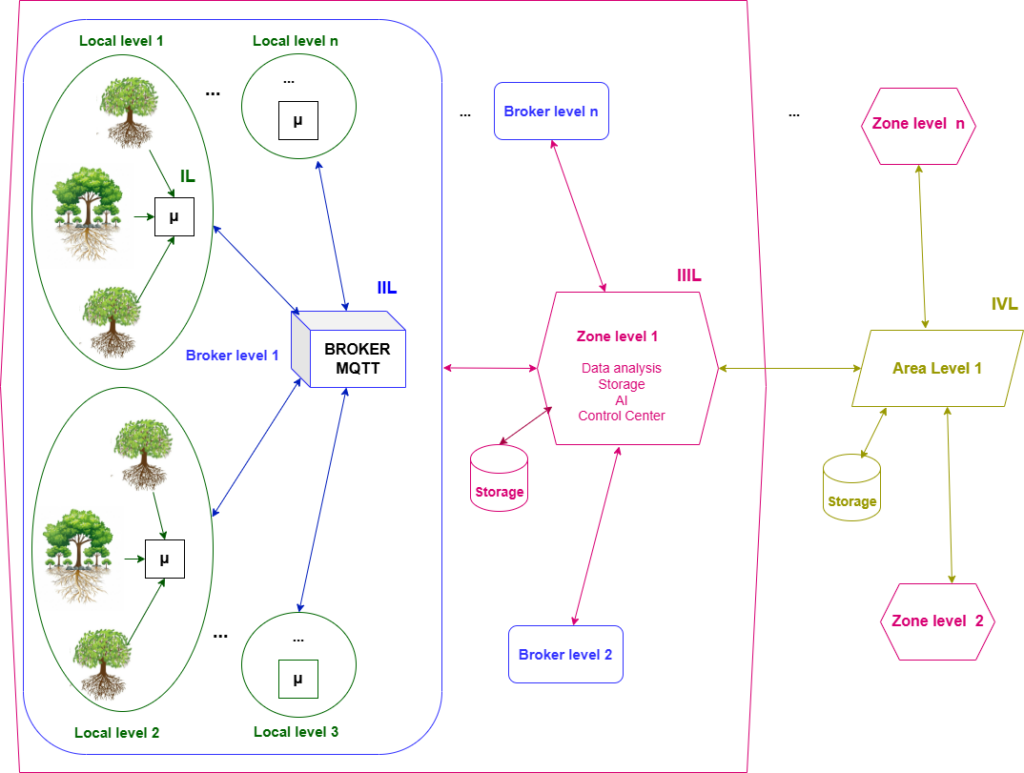
Let’s see what happens at each level:
- IL (Local Level): There are sensors that connect a microcontroller (µ) to trees and plants and measure various biological parameters; there could also be actuators that
- IIL (Broker Level): The microcontrollers collect data, clean it by removing noise and interference, and send it to a server (Broker) using the MQTT protocol (a very common protocol in IoT).
- IIIL (Zone Level): Through a network connection, all MQTT Brokers send data to a Zone Server. This server could have various functions:
- data aggregation,
- data analysis,
- data storage,
- data presentation and publication,
- data interpretation with Machine Learning algorithms,
- execution of various types of applications based on AI systems.
- IV (Area Level): Zone Servers send aggregated data to Area Servers for higher-level and more general analysis.
Communication between devices and aggregators can occur at each level in various ways: ethernet, wifi, bluetooth, etc.
As mentioned earlier, the technologies to create such a system already exist, perhaps in future posts we could consider looking in detail at what they are and how to use them.
Conclusion
The Internet of Plants is an interdisciplinary frontier between biology, sensing, and informatics. Understanding and leveraging plant signals can open new scenarios for sustainable agriculture as well as for monitoring and protecting the environment around us. It is a rapidly developing field with enormous potential that could lead to advanced knowledge and consequently useful and innovative applications. We hope that researchers and scientists working in this field will find the necessary funds to carry out further experiments in the coming years.
Sources and References
- Verde brillante, Stefano Mancuso, Alessandra Viola, Giunti, 2019.
- La mente delle piante – Introduzione alla psicologia delle piante, Umberto Castiello, Il Mulino, 2020.
- Così parlò la pianta. Un viaggio straordinario tra scoperte scientifiche e incontri personali con le piante, Monica Gagliano, Nottetempo, 2022.
- L’Albero Madre, Suzanne Simard, Mondadori, 2023.
- Stefano Mancuso: Alla radice dell’intelligenza delle piante, Stefano Mancuso, Ted Talks.
- Le piante sono coscienti?, Stefano Mancuso, Ted Talks.
- The Internet of Vegetables: How Cyborg Plants Can Monitor Our World, Klint Finley, Wired, 2014.
- Kickstarter of the Week: Plant-In City Offers an Internet of Vegetation by Tim Maly on Wired, 2012.
- An “Internet of Plants” Could Tell Farmers When Crops Need Watering by Stav Dimitropoulos, Scientific American.
- Elowan: A plant-robot hybrid, MIT.
- PLants Employed As SEnsor Devices, project site.
- Pleased KIT, on GitHub (official product of the project???).
- Plants as sensing devices, various authors, paper on the results of the PLEASED project.
- CROPPS – Center for Research on Programmable Plant Systems, project site.
- CROPPS, on Wikipedia.
- TEDxRoma, le piante come sensori: interview with Andrea Vitaletti on Wired.
- Innovare con i piedi per terra e la testa fra le nuvole, TEDx by Andrea Vitaletti.
IoP (Internet of Plants) on this blog
- Il broker e la piantina
- Agrumino Lemon: Prima installazione e configurazione.
- IoP: Usare Mosquitto come broker Mqtt
- Installazione di Node-RED per la progettazione di flussi in ambito IoT
- IoP – Internet Of Plants
*** Note: This article was translated using an automated workflow created with n8n and OpenAI.